Remembering Australia’s greatest Catholic hymn writer 50 years on
By Catherine Sheehan
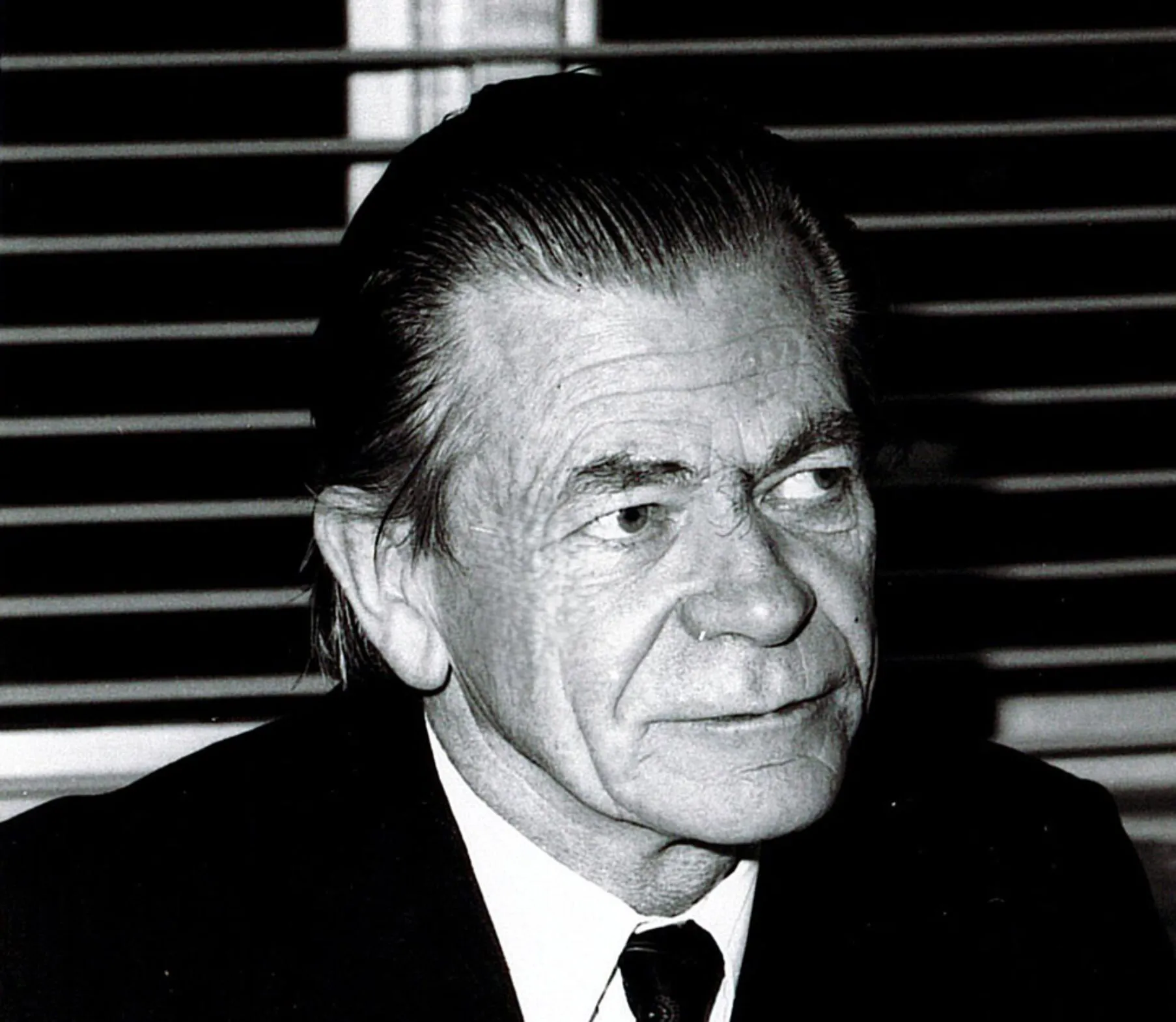
This month marks 50 years since the death of James McAuley, the man considered to be Australia’s most significant Catholic hymn writer. He wrote the words to beloved treasures such as ‘By Your Kingly Power, O Risen Lord’, ‘In Faith and Hope and Love’, ‘Seek O Seek the Lord’, ‘Sing a New Song’ and ‘Where There is Charity and Love’.
McAuley wrote the lyrics of 22 hymns, with the accompanying music composed by musician Richard Connolly (1927-2022) with whom he enjoyed a close friendship and collaboration over many years.
Many Tasmanian Catholics may not realise that McAuley, who was a talented poet, academic and political activist, lived on the Apple Isle for the last period of his life until his untimely death on 15 October 1976. McAuley lived with his wife Norma and their children on Marsh Street in New Town from 1961. They attended Sunday Mass together at Sacred Heart Church, New Town, where he was known to play the organ with great gusto while his wife led the choir in song, and their sons served at the altar.
McAuley’s daughter Katherine Westlake still lives in New Town and attends Mass at Sacred Heart. Hearing her father’s hymns still played at Mass on a regular basis makes her “very proud” she said.
“It brings back sad memories too, because of losing him so early, but lovely memories,” she said.
“I remember him talking about the hymns but not really realising how many there would be and how important.”
Her brother Timothy McAuley describes his father as a man of “remarkable intellect” and “a very loving father”.
“I’m still in awe of his intellect,” Timothy said. “He thought on a level so far above the rest of us that it was hard to comprehend.”
James Phillip McAuley was born in the western Sydney suburb of Lakemba on 12 October in 1917, a year of both revolution and revelation. It was the year of the Russian Revolution and of the apparitions of Our Lady at Fatima, an interesting fact given the impact of both the rise of Communism and the Catholic faith on McAuley’s life.

He was born to an Anglican mother and a lapsed-Catholic father who had made a vow never to revert to the faith of his childhood. McAuley obtained a Master of Arts degree at Sydney University, and worked as a school teacher for a period of time.
In 1942 he married Norma Abernethy and they went on to have six children together—Katherine, Philip, Michael, Timothy, Stephen, and Andrew, who sadly died soon after birth.
Towards the end of the Second World War McAuley began working as a lecturer for the Australian School of Pacific Administration, a position which required him to travel frequently to Papua New Guinea. It was in New Guinea that McAuley experienced a major spiritual conversion which led him to enter the Catholic Church.
In New Guinea he encountered the French Missionaries of the Sacred Heart and heard about the life of Marie-Thérèse Noblet (1889-1930), who was considered to have lived a holy life. He also met and was greatly influenced by Archbishop Alain Guynot de Boismenu (1870-1953), who had been Noblet’s spiritual director. He described the bishop as “a magnificent witness” because of his “intelligence, candour, probity, and holiness”.
McAuley later wrote: “Between June and July 1951, I had become sure I would have to ask to be received into the Church, but reserved my decision till I went back to Papua, feeling in all sorts of obscure ways that the mission and Marie-Thérèse Noblet were somehow central in my development: they had evidently helped to create the dispositions with which I examined the claims of the Church.”
He was baptised in May 1952 at St Charles Borromeo Church in Ryde, Sydney, and dedicated a poem to the priest who baptised him, Fr Phillip Reeve:
Queen of Heaven, as we revere
The Word that formed your story,
So from our long distraction here
Receive us into glory.
His wife was baptised in January 1953, and they were both confirmed in November 1953.
In 1952 McAuley and his wife tragically suffered the loss of their youngest child Andrew, who survived only a day after his birth.
McAuley expressed his profound sorrow in his poem ‘Pietà’:
A thing so dark and deep
So physical a loss:
One touch, and that was all
She had of you to keep.
Clean wounds, but terrible,
Are those made with the Cross.
In the mid-1950s McAuley became involved with the Democratic Labor Party and The Catholic Social Movement. He was a vehement proponent of the fight against the influence of Communism in Australian politics and society. Eventually becoming disillusioned and frustrated by divisions within the Movement and by internal Church politics, McAuley expressed his sentiments in his well-known poem ‘Retreat’:
It is not said we shall succeed,
Save as his Cross prevails:
The good we choose and mean to do
Prospers if he wills it to,
And if not, then it fails.
Nor is failure our disgrace:
By ways we cannot know
He keeps the merit in his hand,
And suddenly as no one planned,
Behold the kingdom grow!
In 1956 McAuley became founding editor of Quadrant magazine, a quarterly literary journal. It was another means he used to fight the pervasive influence of Communism in Australian culture and society.
In 1960 he was offered the position of Reader in Poetry at the University of Tasmania. The whole family relocated to Hobart in 1961, taking up residence in Marsh Street in New Town, and shortly after McAuley became Professor of English at UTAS.
It was during the early 1960s that he wrote most of his hymns in collaboration with musician Richard Connolly. He would write the lyrics of a hymn then post the text to Connolly, who lived in Sydney, so he could compose the music.
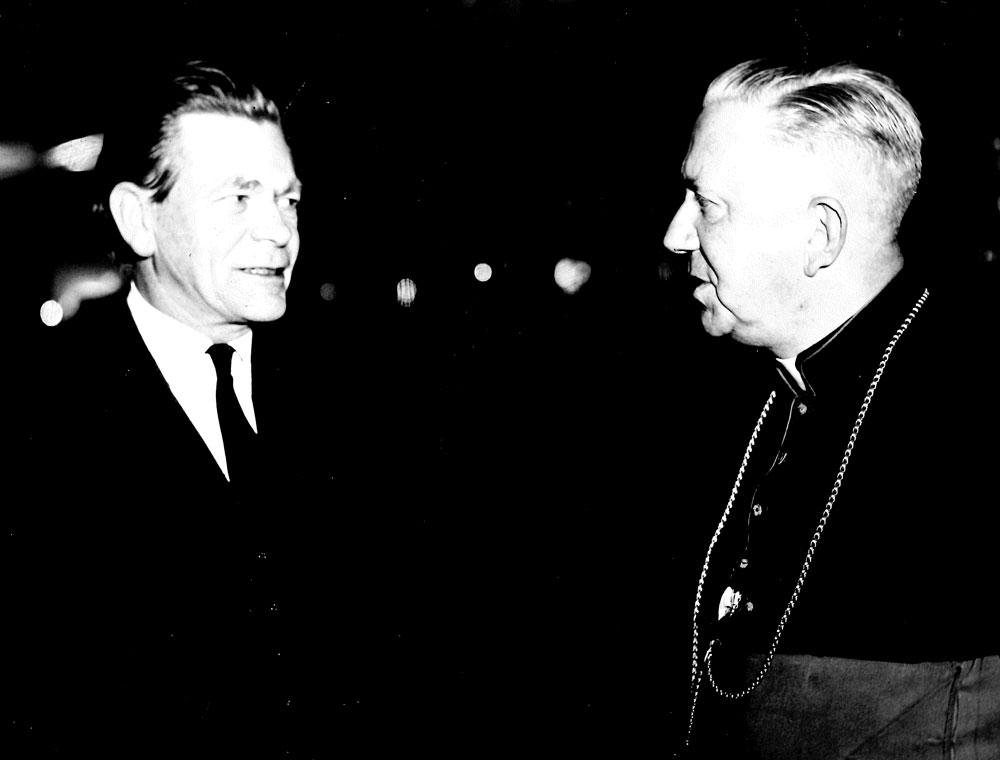
Connolly later wrote of his “excited realisation” upon receiving the first of McAuley’s texts “that this was as near perfection as I would ever want to see, with not a word or a phrase or even a syllable that a composer or a theologian or a liturgist would want to change”.
“No one could encapsulate the essential, eternal meanings and resonances like McAuley, steeped as he was in the Word, especially the Gospels and St Paul,” Connolly wrote.
In 1970 McAuley was diagnosed with bowel cancer. He died in 1976 and was laid to rest at the Cornelian Bay cemetery.
Timothy McAuley describes his father’s Catholic faith as “cerebral” and said he had a deep devotion to the Blessed Virgin Mary.
“He had a very deep faith, but it was intellectual… the basis of his faith was so strong.”
Katherine said her father had a gift for connecting with people from all walks of life.
“He had charisma,” she said. “He loved talking to people.”
“He was just so loved by everyone who met him,” Timothy added.
“His students adored him and they still remember him.”
Teresa Sheehan who currently plays the organ and leads the choir at Sacred Heart in New Town said she enjoys playing McAuley’s hymns and honouring his musical legacy.
“I find his music is still relevant yet timeless, insightful yet prayerful,” she said.
“James McAuley established a treasury of hymns which serve the Catholic Church in Australia to this day.
“I hope these hymns remain familiar to all church-goers in Australia and proudly sung by Tasmanians in particular.”
The depth of McAuley’s Catholic faith continues to resound in his hymns today as they are sung in churches around Australia.
Perhaps it could be said that his abiding faith is well encapsulated in his rousing hymn, ‘By Your Kingly Power O Risen Lord’ which contains the following wonderful lines, so full of joy and hope:
Sing the joyful Easter cry,
Sound it to the souls in prison,
Shout our triumph to the sky:
Sing Christ risen, sing Christ risen.