How a painting and a poem led Fr Michael to walk the pilgrimage of priesthood

By Catherine Sheehan
When the news broke in the early afternoon on 5 June that Fr Michael Tate AO, Parish Priest of South Hobart, had died aged 80 at Calvary Hospital in Lenah Valley it was difficult for many to comprehend.
A prominent figure for decades, not only in the Catholic Church in Tasmania but also in the broader community, a priest, and a friend to many, had suddenly been taken away.
The response was swift when the sad news was announced on the Archdiocese’s Facebook page—an outpouring of grief and fond memories.
He had clearly impacted the lives of many.
When he was interviewed for a podcast in 2019 (‘Life & Faith’ podcast, 20 November 2019), Fr Michael explained the seeming enigma of his life’s journey—why after highly successful careers as a legal academic, a politician and a diplomat, he had chosen to become a priest in his fifties.
He put it down to his heart being “nudged” by a painting and by a poem.

Michael Carter Tate was born in Sydney on 6 July 1945. He moved to Hobart with his family where he was educated at St Virgil’s College.
He chose to study law after completing his secondary schooling because of his love of words. During first year law at the University of Tasmania, he was involved in a serious car accident which left him in hospital for five long months.
His hospitalisation had “bankrupted” his parents, he later said, and this experience led to him later becoming a Labor politician advocating for better healthcare in Australia.
Michael had to repeat first year law due to his long stay in hospital, something which meant he “did extremely well”.
He graduated with First Class Honours in 1968 and obtained a Commonwealth of Nations scholarship to study law at Oxford University. In his first year at Oxford however, he switched to theology, a move he described as “rather impulsive”.
He had to learn ancient Greek in one-and-a-half terms, however, the experience imbued him with a love of scripture which he never lost.
It also gave him an interesting claim to fame: “According to my tutor… I was the first Catholic to study for the BA in theology since the Reformation… It’s such a good story. I’ve never checked it,” Fr Michael had said.

After graduating with his master’s degree in theology in 1971, he returned to Hobart and lectured in law at the University of Tasmania from 1972 to 1978. He was Dean of Faculty from 1977 to 1978.
In 1977 he was elected to the Senate representing Tasmania.
He served as Federal Minister for Justice from 1987 to 1993, for both the Hawke and Keating governments.
During his time in politics he helped to have conscription outlawed and wrote Australia’s Citizenship Pledge, something he considered his “most enduring achievement” in politics.
In 1994 he was appointed Australia’s Ambassador to the Holy See and to the Hague.
In 1996 he was appointed an Officer of the Order of Australia for his distinguished service to Australia.
It was during his time as an Ambassador that he began to think seriously about the priesthood.
One “nudge” in that direction was Caravaggio’s painting ‘The Calling of St Matthew’ which is housed in the church of San Luigi dei Francesi in Rome.

The painting depicts the Gospel passage when Christ calls Matthew the tax collector to leave his familiar life and become one of his disciples.
“Something was in my heart saying, ‘you can’t keep on procrastinating, and putting it off, and saying somebody else should respond to the call to the Christian ministry in our Church, which is the priesthood,” Fr Michael had later said.
Then in Lent of 1996 he read a poem by W. H. Auden titled, ‘The Cave of Making’. He was particularly struck by the lines: “God may reduce you on Judgment Day to tears of shame, reciting by heart the poems you would have written, had your life been good.”
“Well, that hit me like a grenade thrown at me,” Fr Michael said. “Was I going to be crying tears of shame on my death bed because I didn’t have the courage or the guts to write the poem which God always intended me to write, the poem of the priesthood?”
“I knew from even school days at St Virgil’s that something in me was calling me to that particular role. So I’ve tried to scribble a few stanzas.”
As he finished his term as Ambassador to the Holy See he told Pope St John Paul II that he planned to become a priest. The Pope responded with surprise, “Are you? This is what we call a late vocation.” Michael replied, “No, Your Holiness, it’s an early vocation long deferred.”
He was ordained a priest at the age of 54 on 19 May 2000 by Archbishop Adrian Doyle at St Mary’s Cathedral in Hobart.

Fr Michael went on to serve as Parish Prest at Bridgewater-Brighton, Sandy Bay, Huon Valley, and the parish he grew up in, South Hobart. He also served the Archdiocese as a Consultor, a member of the Council of priests, and as Vicar General.
He founded the popular Way to St James Cygnet, an annual pilgrimage through the beautiful Huon Valley. Based on the Camino de Santiago in Spain, the Tasmanian pilgrimage attracts large numbers each year. During Covid 19 the pilgrimage became global.
Fr Michael loved the preaching aspect of priesthood and was particularly keen on the ‘cosmic’ view of Christianity.
“I’m a great follower of St Paul in Romans [chapter] eight, where he portrays the whole cosmos as being able to be transformed by the resurrection power of Our Lord Jesus Christ.
“This dynamic, energising, power of the Holy Spirit throughout the whole cosmos, transforming all matter by the death-conquering resurrection of Our Lord Jesus Christ.”
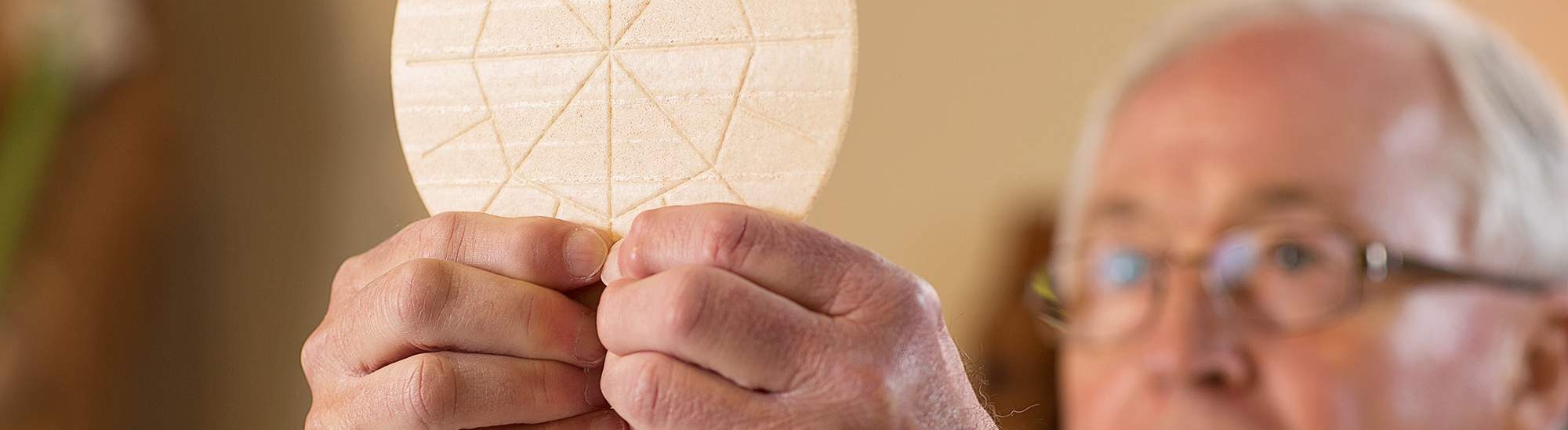
“Now at a Mass, with the little elements of bread and wine, we believe that that transformation of the cosmos begins. Of course, not a molecule changes in the bread or the wine, but what one receives is the risen Lord Jesus Christ.
“So already matter is being transformed in the way in which St Paul envisages for the whole cosmos.
“For me to be a minister in that process, is just the most fantastic part of the whole priesthood.”

Right up until the end Fr Michael was making plans. He revealed in recent times that he wanted to establish a Franciscan centre for people to learn about caring for God’s creation through the lens of St Francis of Assisi.
Long-time Volunteer and pilgrim with the Way to St James Cygnet, Leanne Prichard, said that while the pilgrimage would never be the same without Fr Michael, she had no doubt it will continue to attract people.
“His legacy will also live on in the minds and hearts of our Tasmanian and Global pilgrims and all who had the privilege of meeting him and walking these pilgrim paths inspired by him,” Leanne said.
Chair of the Parish Pastoral Council at South Hobart, Martin Stone, said he felt “privileged” to have known Fr Michael.
“As a priest, Fr Michael put particular effort into clear and uplifting preaching,” Martin said. “He realised that it was a gift that he had been given to contribute to the mission of the parish, and many people were attracted and inspired by his words.”
Fellow priest and long-time friend, Fr Mike Delaney said he had benefitted from Fr Michael’s “wisdom and insight”.

“He had a great love of his parishioners and worked tirelessly in all of his pastoral appointments,” the Kingston Parish Priest said.
“He also had a love and care for his brother priests and would regularly make contact and visit as he wandered the Diocese. Frequently when I rang him I would begin by greeting him as ‘His Excellency’, [and asking] in what part of the world are you today?’
“He was a giant amongst us and his absence will be felt for generations as the memory of his achievements impact people in generations to come.”