Corpus Christi 2026

Saturday 5pm Vigil Mass at St Mary’s Cathedral
Welcome to everyone gathered in St Mary’s Cathedral this evening.
One of the great tragedies of the human heart is forgetfulness. Not forgetfulness of names or dates, but forgetfulness of God. That is why Moses speaks so urgently to the people of Israel in today’s first reading. They have come through the wilderness. They have known hunger, thirst, uncertainty and fear. Yet now as they stand on the threshold of a new future, Moses worries that prosperity may prove more dangerous than hardship. “Do not forget the Lord your God,” he says. Remember the One who fed you with manna in the desert. Remember the One who brought water from the rock. Remember the One who carried you when you could not carry yourself.
The Feast of Corpus Christi is, above all, a feast of remembrance. Not mere recollection nor nostalgia. The Eucharist is a living memory.
Pope Francis once said that in an age of frantic activity and constant distraction, we risk living only on the surface of things. We move from one moment to the next, one headline to the next, one screen to the next, and gradually lose sight of who we are and whose we are.
The Eucharist restores our memory. It gathers together the scattered fragments of our lives and reminds us that we are loved by God. It reminds us that Christ has died for us, is risen for us, and remains with us.
Today’s Gospel takes us into the heart of that mystery. Jesus does not simply say that he will give bread. He says: “I am the living bread which has come down from heaven.” The manna in the desert sustained Israel for a day. The Eucharist sustains us for eternity. The manna was a gift. The Eucharist contains the Giver. The manna fell from heaven. In the Eucharist, heaven itself comes down to us.
Jesus does not offer us an idea, a philosophy or a set of principles. He offers himself. “This is my Body.” “This is my Blood.” Those words are so familiar that we can almost desensitize their astonishing claim. Yet St Thomas Aquinas reminded his readers that these are the words spoken by the Lord on the night before he died. They are among the last words of Jesus before Calvary. And when someone we love speaks their last words, we listen carefully. We treasure every syllable. We know that nothing is accidental.
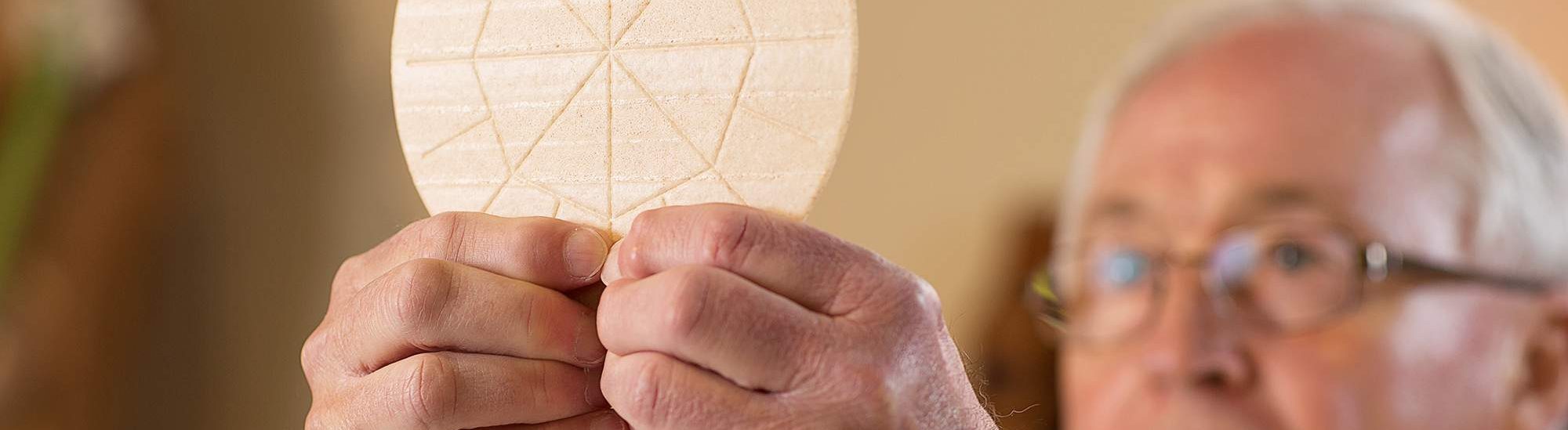
The Eucharist is Christ’s final will and testament of love. It is not simply a symbol of his presence. It is his presence. Body and Blood, Soul and Divinity. The same Lord who walked the roads of Galilee, who healed the sick, forgave sinners, embraced children, suffered on the Cross and rose from the tomb, comes to us under the humble appearances of bread and wine. That is why we adore. That is why we kneel. That is why the Church has spent two thousand years building churches, composing hymns, lighting candles and offering incense before the Blessed Sacrament. Not because bread is holy. But because Christ is here.
Today’s second reading reminds us that the Eucharist is never merely about my relationship with Jesus. “The fact that there is only one loaf means that, though there are many of us, we form a single body.” The Eucharist does not simply unite us to Christ. It unites us to one another. Every Mass is a lesson in communion. We come from different places, different backgrounds, different occupations and experiences. Some of us are young. Some are old. Some are flourishing. Some are carrying heavy burdens. Yet at this altar we become one body because we receive one Lord.
The Eucharist is the great antidote to division. It teaches us that we belong to one another. It teaches us that faith is never a private possession. It teaches us that the Church is not a collection of isolated individuals but a family gathered around the table of the Lord. And from this altar we are sent out. The Eucharist is not an escape from the world. It is preparation for mission.
We receive the Body of Christ so that we may become the Body of Christ for others. We are fed so that we may feed. We are loved so that we may love. The Lord whom we adore in the Blessed Sacrament waits for us in the lonely, the sick, the poor, the forgotten and the searching.
As we celebrate this great feast let us ask for the grace of grateful memory to remember what the Lord has done for us and the countless ways he has sustained us throughout our lives. Approaching this altar this evening, let us hear once more those life-giving words of Jesus: “I am the living bread which has come down from heaven.” May this Bread of Heaven strengthen us for the journey, deepen our communion with one another, and lead us at last to that heavenly banquet where every hunger is satisfied and every tear is wiped away.
Most Rev. Anthony J. Ireland
Archbishop of Hobart
6 June 2026