Pilgrims of the Eucharist: Towards the International Eucharistic Congress Sydney 2028

A Pastoral Letter to the People of the Archdiocese of Hobart
Most Rev. Anthony J. Ireland DD, STD
Dear People of God,
Forty years ago, on 27 November 1986, something remarkable happened on Tasmanian soil. Pope St John Paul II came among us as a pilgrim, a pastor, and the Successor of St Peter. Here in our Archdiocese, he celebrated the Eucharist and strengthened the faith of our people.
Those who were present still remember the joy, the reverence, and the sense that Tasmania itself had been drawn into something larger than itself—into the beating heart of the universal Church.
The words spoken by St John Paul II during that visit remain luminous and urgent for us today. Speaking to the Catholic people of Tasmania, he reminded us:
“Jesus does not merely say: ‘You are the light of your own home’, or ‘You are the light of your local Christian community’. Instead, he directs them out to the larger society, beyond the boundaries of the familiar and well known, beyond the boundaries of the Church. He declares that they are ‘the light of the world’.”
Those words are perhaps even more important now than they were in 1986. Tasmania has changed. Australia has changed. Many people no longer know the language of faith. Many carry hidden wounds, loneliness, uncertainty, or disappointment. Ours is increasingly a society searching for meaning while often forgetting where meaning is truly found.

Yet Christ remains among us.
And nowhere is he more intimately present than in the Eucharist.
As we journey towards the International Eucharistic Congress to be held in Sydney in 2028, the Church in Australia is being invited not merely to organise an event, but to rediscover a mystery. The Eucharistic Congress cannot simply be a gathering of pilgrims, conferences, liturgies, and processions. It must become a moment of Eucharistic renewal—a renewal of hearts, of parishes, of families, of priesthood, of mission and of hope.
The Eucharist is not one devotion among many. It is the beating heart of the life of the Church.
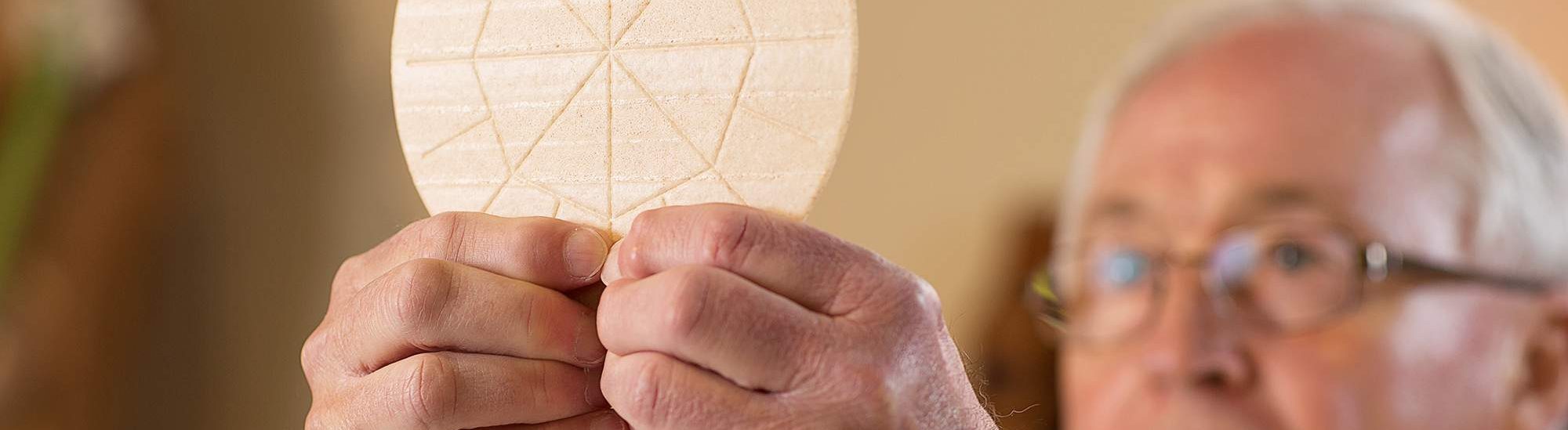
The Second Vatican Council described the Eucharist as “the source and summit of the Christian life.” Everything in the Church flows from it and returns to it. In the Eucharist, Christ does not merely remind us of his love; he gives himself entirely. His body. His blood. His soul and divinity. His abiding presence among us.

St Augustine urged the early Christians:
“Recognize in the bread what hung on the cross, and in the cup what flowed from his side.”
The Eucharist is not an idea. It is not a symbol emptied of reality. It is Jesus Christ himself—crucified, risen, and glorified—who feeds his people along the pilgrimage of life’s history.
This is why saints loved the Eucharist with such intensity. St Thomas Aquinas, the great theologian, would often weep while celebrating Mass. Pope Francis reminded us that before we ever desire Christ in the Eucharist, Christ has already desired us. Every Mass is the fulfilment of his longing to remain with his people.
The Eucharist forms us into a people of hope.
In Tasmania, hope has always been needed. St John Paul II recognised this when he reflected on the beginnings of the Catholic faith on this island:
“At the beginning of the nineteenth century, the Catholic faith was sown here against many odds. Your forebears came with both hope and anxiety to a land that perhaps seemed then rather unpromising.”

Those early Catholics built churches, schools, and communities often in conditions of hardship and isolation. Priests travelled long and hard distances. Religious sisters taught children in remote towns. Families preserved the faith through sacrifice and perseverance. Their legacy is not merely historical. It lives in us.
And so, St John Paul II continued:
“As the Successor of Peter, I have come to join you in giving thanks for your rich heritage and to encourage you to transmit this precious treasure to future generations.”
That task now falls to us.
We can only hand on what we cherish. Eucharistic renewal begins not with programs but with wonder. We must recover awe before the mystery of Christ truly present among us.
This renewal calls us to several things.
It calls us back to Sunday Mass—not as obligation alone, but as encounter. The Eucharist is where heaven touches earth, where weary hearts are strengthened, where sinners receive mercy, where the Word becomes flesh among us.

It calls us to reverence. At the Cathedral, in every parish, chapel and school, the Eucharist should be celebrated beautifully, prayerfully, and faithfully. Beauty evangelises because beauty reveals the splendour of God.
It calls us to Eucharistic adoration. In silence before the Blessed Sacrament, many discover again the peace and presence of Christ. In an anxious and distracted age, adoration teaches us how to remain with the Lord who remains with us.
The Eucharist calls us to mission. It always sends us outward. We cannot receive the Body of Christ and remain indifferent to the poor, the lonely, the unborn, the elderly, the refugee, the forgotten or the wounded. The Eucharist forms us not only for worship but for charity and witness.
And it calls us to become evangelising Catholics once more.
When St John Paul II stood on Tasmanian soil, he declared:
“I want you to know what a joy it is to be with you at this celebration of the Eucharist. Together with you and with the Church throughout the world, I give thanks for the gift of faith which has brought us the salt and light of the Gospel. Let us join our hearts and voices in praising Christ, who, in the first place and above all, is the light of the world.”
Tasmania today needs Catholics who carry that light with conviction and courage. Not angry Catholics, nor fearful Catholics but Eucharistic Catholics—men and women whose lives have been shaped by the presence of Christ.

The Eucharist teaches us who we are.
We are not a people abandoned into darkness. We are pilgrims nourished by heaven. We are a Church walking together through history with Christ in our midst.
As we prepare for the International Eucharistic Congress in Sydney in 2028, I invite every parish, school, religious community, and Catholic family in the Archdiocese of Hobart to begin praying now for a new Eucharistic springtime.
May our churches become places of deeper prayer.
May our liturgies become radiant with faith.
May our priests celebrate the sacred mysteries with renewed love.
May our young people discover again the beauty of Christ.
May those who have drifted away hear once more the invitation of the Lord.
And may we become what we receive: the Body of Christ given for the life of the world.
Forty years ago, St John Paul II came among us to strengthen our faith and encourage our mission. His words are as relevant in today’s Tasmania as they were in 1986. The task he entrusted to us remains unfinished.
It is ours.
The road to Sydney 2028 begins at the altar, before the tabernacle, in the silence of prayer, in the breaking of the bread, and in hearts set ablaze again by the living presence of Jesus Christ.
With every blessing in the Lord,

Most Rev. Anthony J. Ireland
Archbishop of Hobart