Third Sunday of Easter 2026

Welcome to everyone who has gathered to pray.
The Gospel today takes us onto a road—the road to Emmaus—and it is a road we know well. It is not only theirs; it is ours. It is the road of disappointment, of questions left unresolved, of hopes that seemed so certain and yet have faltered.
The two disciples are not paralysed by their grief. They are walking. They are still moving forward. And perhaps that is the first grace: even when hope is shaken, life continues, and we keep going. We rise in the morning, we take the next step, and often without knowing it, we are already on the road where Christ will meet us.
They speak about Jesus as they walk. They rehearse what has happened. They try to make sense of it. They even listen as the stranger opens the Scriptures to them. And yet—they do not recognise him.
St Augustine once said, “Everything in those Scriptures speaks of Christ, but only to him who has ears.” The Word is there. The truth is there. Christ is there—and still, they do not see.
And this is something we must understand: knowing about Jesus is not the same as knowing Jesus. We can speak of him, study him, even admire him—and still not recognise him when he draws near.
There is something missing.
The turning point comes not on the road, but at the table.
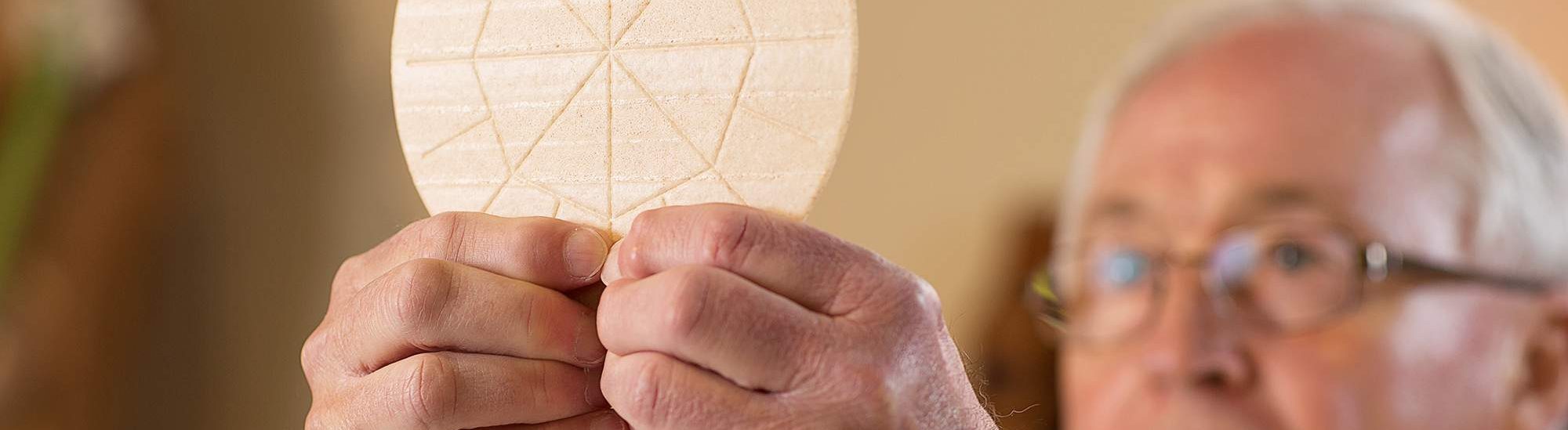
“When he was at table with them, he took the bread, said the blessing, broke it, and handed it to them. And their eyes were opened.”
St Augustine again gives us the key: “Jesus desired to be recognised in the breaking of the bread.”
It is there—in that familiar yet utterly new gesture—that everything changes. Not in explanation, but in encounter. Not in theory, but in presence. Not in words alone, but in the gift of himself.
And in that moment, what had been sorrow becomes fire. What had been confusion becomes clarity. What had been an ending becomes a beginning.
Were not our hearts burning within us?
This is the rhythm of the Christian life. We walk our roads—sometimes bright, sometimes shadowed—and the Risen Lord comes alongside us. He speaks to us in the Scriptures. He is with us in ways we do not yet perceive. And then, in the breaking of the bread, he makes himself known.
Every Eucharist is Emmaus.
Here, Christ the Lord is risen today. Here, the journey of our lives is gathered into his. Here, by his priestly power, ordinary bread becomes the living presence of the risen Lord. Here, faith is no longer abstract but alive—something we receive, something that transforms us.
And having recognised him, the disciples do not stay where they are. “That same hour they set out and returned to Jerusalem.”
They go back—not because the road has changed, but because they have changed. They carry within them the certainty that Christ is alive, that he walks with them, that he is present even when unseen.
And so it is for us.
We are not meant to remain at the table. We are sent—sent into our homes, our workplaces, our communities—to walk with others as Christ has walked with us. To accompany those who are confused or burdened. To listen. To share. To witness.
Our faith is not something we hold for ourselves alone. It is something we live and give—in faith, in hope, and in love.
The disciples began the day speaking about Jesus. They ended the day proclaiming him.
And perhaps that is the question the Gospel leaves with us: Have we recognised him? In the Scriptures, in the Eucharist and on the road of our own lives.
Because when we do, everything changes.
The road is no longer a place of loss, but of encounter.
The table is no longer ordinary, but holy.
And the world—even in its wounds—becomes the place where the Risen Lord is already at work.
And we, like those first disciples, rise… and go.
Most Rev. Anthony J. Ireland
Archbishop of Hobart
18 & 19 April 2026