Third Sunday of Easter 2026 – Sunday evening Mass

Welcome, friends one and all to St Mary’s Cathedral.
The Gospel this evening takes us onto a road we all know well—the road of disappointment, confusion, and quiet endurance. The two disciples are walking away from Jerusalem, away from shattered hopes. They had trusted, they had believed, and now it seems everything has come to nothing. Yet notice this: they are still walking. They are not paralysed. They keep going.
That is already a word for us. We, too, know what it is to carry disappointment. We know what it is to question, to wonder, to feel that something precious has slipped from our grasp. And yet we rise each day, we continue on the road. It is precisely there—in the ordinary, in the unfinished, in the questions not yet resolved—that the risen Lord draws near.
The disciples are talking about Jesus as they walk. They speak of what has happened, they try to make sense of it. And then a stranger joins them. He listens. He walks with them. He begins to open the Scriptures to them.
And still—they do not recognise him.
Here is something very important. They have the conversation. They have the Scriptures. They have the teaching. Their minds are being opened, their hearts are stirred. Yet faith has not yet dawned. As Saint Augustine once said, “Everything in those Scriptures speaks of Christ, but only to him who has ears.” The words are there, the truth is there—but something more is needed.
Because faith is not simply information. It is not even the best explanation. Faith is born of encounter.
How gently the Lord leads them. He does not overwhelm them. He does not force recognition. He walks at their pace. He listens to their story. He opens their eyes slowly—like someone praying, “Open my eyes, Lord, help me to see.” And even then, they still do not fully see.
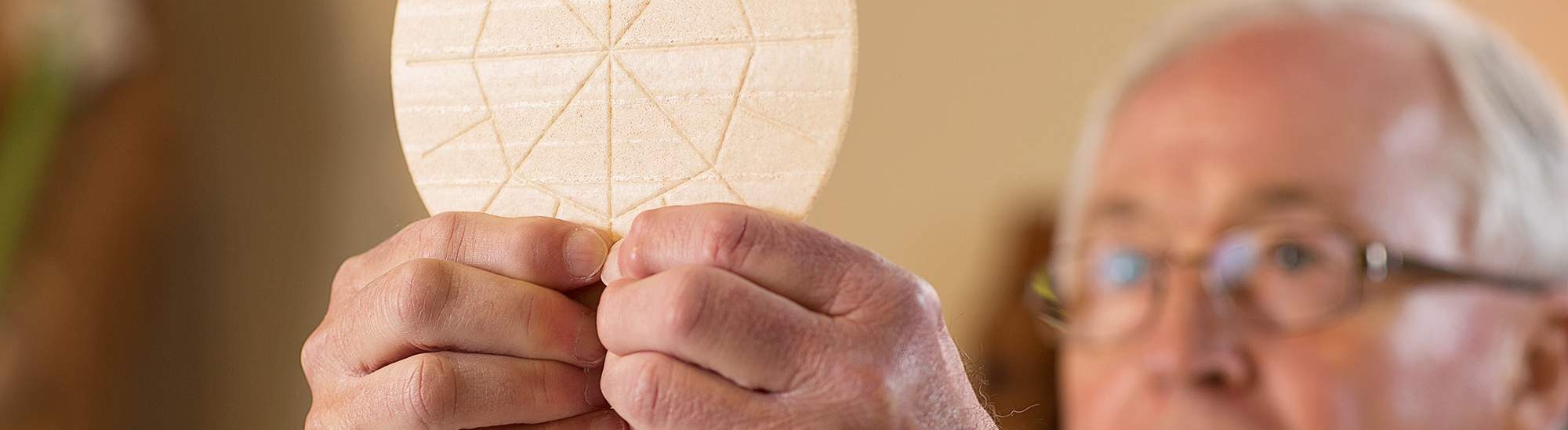
It is only when they reach the table—only when he takes bread, blesses it, breaks it, and gives it to them—that everything changes.
“Then their eyes were opened, and they recognised him.”
And again, Augustine gives us the key: “Jesus desired to be recognised in the breaking of the bread.”
This is the heart of the Gospel. They walked with him and did not recognise him. They listened to him and did not recognise him. But in the breaking of the bread—there, everything became clear.
From that first Easter evening to this very moment, the Church has done the same. We gather. We listen to the Word. And then we come to the table. The bread is taken, blessed, broken, and given. And in that action, simple yet profound, the risen Christ is made known.
The green blade rises from the buried grain. Life comes out of death. What seemed finished is only the beginning. The Resurrection is not an idea—it is a presence. And that presence is given to us here.
When we receive the Eucharist, we are not remembering someone absent. We are encountering the One who is alive. “Eat this bread,” we are invited, “and never hunger again.” Not because all our questions vanish, but because we are no longer alone on the road.
And then—just as suddenly as they recognise him—he vanishes from their sight.
Why?
Because now they see differently. They no longer need to see with the eyes of the body. The eyes of faith have been opened. They realise that he had been with them all along—on the road, in their conversation, in their confusion.
And what do they do?
“That same hour they set out and returned to Jerusalem.”
They go back. Back to the place of fear. Back to the community. Back to the others. But now they go with a new heart, a burning heart. “Did not our hearts burn within us?” they say.
They have become witnesses.
And that is always the pattern. Encounter leads to mission. The Eucharist sends us out. We cannot stay at the table. We are drawn into the life of the world, to walk with others as Christ has walked with us—to be, in our own way, a light for others, a glimpse of that city where God gathers his people in joy.
We do this not by having all the answers, not by mastering every detail of Scripture or theology, but by sharing what we have received: a presence, a love, a hope.
The two disciples did not know everything. But they came to know him. And that was enough.
So today, as we walk our own road—with its questions, its disappointments, its quiet hopes—we are invited to recognise that the risen Lord is already beside us. He speaks in the Scriptures. He listens to our hearts. And above all, he gives himself to us in the breaking of the bread.
May our eyes be opened.
May our hearts burn within us.
And may we go forth from this Cathedral, carrying the light we have received, until the whole world becomes, in him, a city filled with the glory of God.
Most Rev. Anthony J. Ireland
Archbishop of Hobart
19 April 2026