
Catholic College of Educational Leaders Mass – 5 March 2026

Thursday of the Second Week of Lent: Jeremiah 17:5–10; Luke 16:19–31
At the end of a year, we usually gather to give thanks for what has been achieved. Today is different.
Today, a few weeks into the school year, we gather not to look back, but to begin again—to place this year, its hopes, its challenges, and its unknowns, into the hands of God.
And it is fitting that we do so here, in St John’s Glenorchy, because leadership in Catholic education is not simply a profession. It is a mission of the Church. It is a work of the Gospel.
The readings chosen for today speak directly into that mission.
Through the prophet Jeremiah we hear a powerful image:
“A blessing on the one who puts their trust in the Lord… She/he is like a tree planted by the water… it has no worries in a year of drought and never ceases to bear fruit.”
This is the first word for the beginning of the year: where you place your trust matters.
Schools begin the year with many demands—staffing pressures, enrolments, compliance, wellbeing concerns, budgets, expectations from parents and systems. It is easy, even for good leaders, to begin relying only on strategies, structures, and sheer effort.
But Jeremiah reminds us: leadership that relies only on human strength becomes anxious and brittle. Leadership rooted in God becomes resilient, calm, and quietly fruitful.
You are called to be that tree—planted near living water.
The living water is prayer.
The living water is the Word of God.
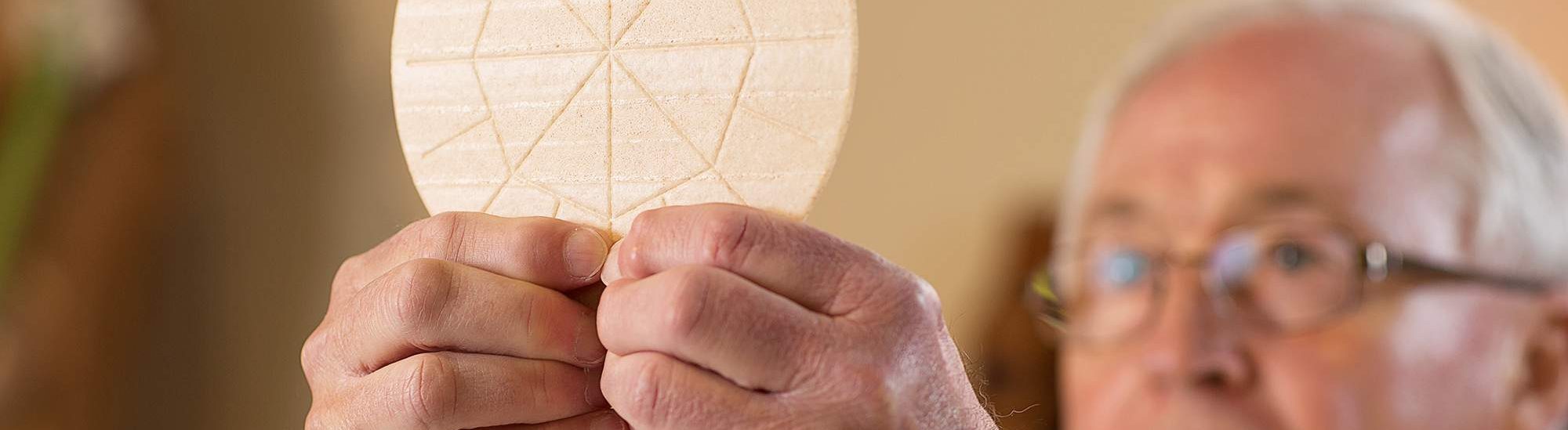
The living water is the Eucharist.
The living water is the quiet conviction that this work is not yours alone—it is the Lord’s.
If you remain planted there, then even in a difficult year—and every year has its difficulties—you will still bear fruit.
The Gospel takes us further.
The story of the rich man and Lazarus is not really about wealth. It is about seeing.
The rich man’s failure was blindness. Every day he stepped over Lazarus and did not notice.
This is the second word for the year: pay attention to the person on the edge or at the gate.
In your schools, Lazarus will appear in many forms:
- the anxious child who cannot settle,
- the teacher quietly burning out,
- the family carrying unseen hardship,
- the student who no longer believes they matter,
- the person in the office who thinks that the teaching staff don’t appreciate their efforts.
Catholic leadership is not measured first by performance indicators. It is measured by who gets noticed, who gets dignity and who is lifted up.
When a school truly sees people, the Gospel is already being preached.
Two weeks into the year, you may already feel the pace quickening. The calendar fills up and the urgent can crowd out the important.
So let me suggest three points for this year.
First: Stay planted by the stream: Guard your prayer. Leaders who do not pray eventually run on empty.
Second: Stay attentive: Make time to walk the grounds. Visit classrooms. Notice faces. The culture of a school is shaped by what the leader sees and affirms.
Third: Stay missionary: In Tasmania, where the proportion of active faith is low, our schools are often the first and sometimes the only place where young people encounter the Church. Your leadership is evangelisation—often quiet, patient, and relational—but profoundly important.
There is one more truth from Jeremiah:
“The Lord searches the heart.”
At the beginning of the year, that is a consoling word.
God is less interested in perfection than in your intention.
Less interested in outcomes than in your faithfulness.
Less interested in success than in the love with which you lead.
If your heart is given to the young, to your staff, and to Christ—then this year, whatever it brings, will bear fruit.
A few weeks in, the year already has momentum.
But today we pause.
We plant ourselves again beside the living water.
We ask for eyes to see the Lazarus at our gate.
And we entrust our schools, our communities, and ourselves to the Lord.
May you be leaders who notice.
May you be leaders through whom young people discover hope.
And may this year, in every one of your schools, become not just a successful year—but a year of lasting grace.
Most Rev. Anthony J. Ireland
Archbishop of Hobart
5 March 2026