
Proclaiming our faith in the Real Presence

Feast of Corpus Christi
As the time of his public ministry was coming to a close the Lord put in place three important foundations for his future Church.
Firstly, from among his many disciples he chose twelve whom he called “apostles’. From their number he chose Peter as their leader.
Secondly, at his Ascension he gave them their mission: they were to go out to all the world, preach the Gospel, baptise those who responded and then catechise them forming them in the Christian life. In instructing them to baptise converts the Lord introduced the sacramental dispensation for his Church.
Thirdly, He established the Eucharist. At the Last Supper after saying the words, “this is my body”, “this is my blood”, over the bread and the wine, he instructed his disciples to “do this in memory of me”. This was to form the key sacramental action which would be the foundation of the Lord’s ongoing and deeply personal communion with his disciples.
Thus, we read in the description of the life of the early Church in the Acts of the Apostles: “These remained faithful to the teaching of the Apostles, to the brotherhood, to the breaking of the bread, and to the prayers” (Acts 2:42). The “breaking of the bread” was the way the Eucharist was described. From the very beginning the celebration of the Eucharist was integral to the life of the Christian community.
The early Church clearly understood the meaning of what they were doing. In the second reading today we read of St Paul’s testimony to the faith of the early Church. He commented, “Every time you eat this bread and drink this cup you are proclaiming his death”. At every Eucharist the Christian community was uniting itself with the saving death of Christ on Calvary. The Eucharist was the Sacrament of the Sacrifice of Christ.
From the very beginnings of the Church the celebration of the Holy Eucharist was central to its life. As it is central to the life of the Church today.
One of the early witnesses to the way in which the first Christians celebrated the Eucharist was St Justin Martyr who lived in the first part of the second century.
He describes the practice of the Christians of his day in these words,
And on the day called Sunday, all who live in cities or in the country gather together in one place, and the memoirs of the apostles or the writings of the prophets are read, as long as time permits; then, when the reader has ceased, the president verbally instructs and exhorts to the imitation of these good things. Then we all rise together and pray, and, as we said before, when our prayer is ended, bread and wine and water are brought, and the president in like manner offers prayers and thanksgiving, according to his ability, and the people assent, saying Amen; and there is a distribution to each. (First Apology 67)
In these words, we see a description of what we do at Mass – there is readings from Scripture, a homily, offertory, Eucharistic Prayer and then Holy Communion.
St Justin comments what the Christians of his time understood as to the meaning of receiving Holy Communion, saying,
For not as common bread and common drink do we receive these; but in like manner as Jesus Christ our Saviour, having been made flesh by the Word of God, had both flesh and blood for our salvation, so likewise have we been taught that the food which is blessed by the prayer of His word, and from which our blood and flesh by transmutation are nourished, is the flesh and blood of that Jesus who was made flesh (ibid 66).
Here is clear testimony to the belief of the Church in the real presence of the Lord in the Eucharist. The Eucharist is, as St Justin Martyr, testifies “the flesh and blood of Jesus”.
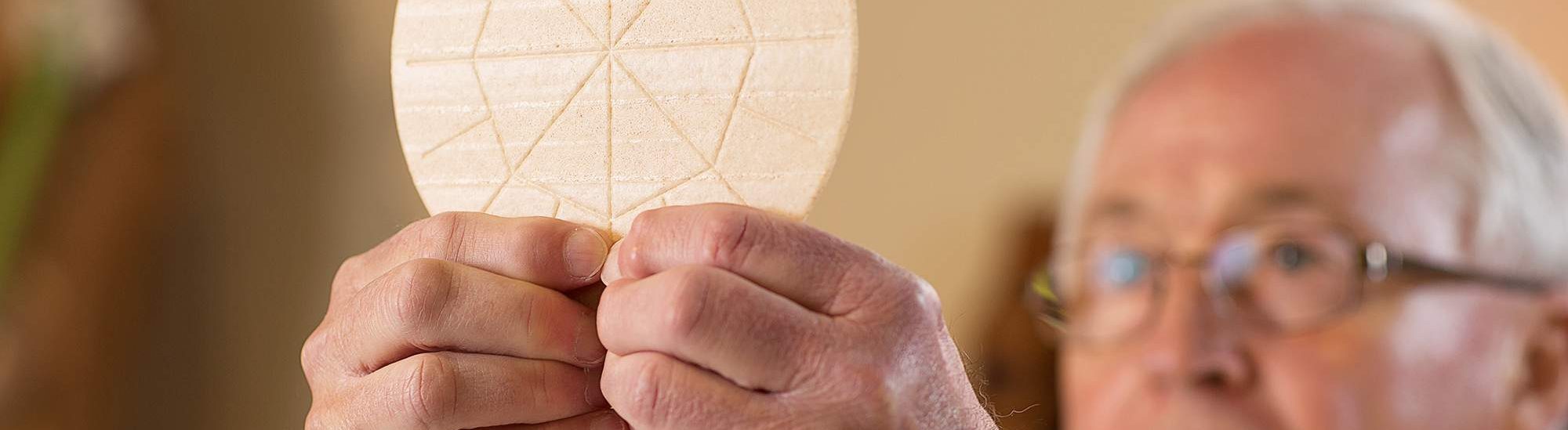
On this feast of Corpus Christi each year the Church proclaims its faith that the bread and wine are truly the Body and Blood of Jesus our Saviour.
From the thirteenth century the Church has commemorated this feast by public processions of the Blessed Sacrament through villages and towns. Thus, will do today in Hobart and Pope Leo will do through the streets of Rome.
We joyfully declare our faith in such a wonderful gift and invoke the blessing of the presence of the risen Lord on our towns and cities.
As St Justin Martyr said that the people assent by saying “Amen”, today as we approach the altar and the priest holds the host before us and says “Body of Christ”, let us declare our unwavering faith that this is indeed the Body of Christ and say with deep conviction and great gratitude, “Amen”.
××××
Brothers, those to be installed as Acolytes today, I say to you: understand that in this ministry at the altar you are being drawn to serve the Eucharistic mystery more closely. Always preserve great reverence for the Real Presence of our risen Lord. May this ministry be a means by which you come into a deeper and more personal union with your Eucharistic Lord.
Archbishop Julian Porteous
Sunday, 22 June 2025