
Godhead here in hiding

Feast of Corpus Christi
Godhead here in hiding
Whom I do adore
Masked by these bare shadows,
Shape and nothing more,
See, Lord, at Thy service
Low lies here a heart
Lost, all lost in wonder
At the God Thou art.
Seeing, touching, tasting
Are in Thee deceived;
How says trusty hearing?
That shall be believed;
What God’s Son has told me,
Take for truth I do;
Truth Himself speaks truly
Or there’s nothing true.
These words were written originally in Latin by St Thomas Aquinas as a hymn of thanksgiving upon receiving Holy Communion. The English translation was made by the Jesuit poet Gerard Manley Hopkins.
When Pope Urban IV, in 1264, was about to establish the Solemnity of Corpus Christi he asked the eminent Dominican theologian, Thomas Aquinas, to compose the Divine Office for the Feast.
Thomas went to the cathedral at Orvieto, a medieval town that stands on top of a cliff, about an hour’s drive north of Rome. It was here that the Pope had seen evidence of a eucharistic miracle. At Orvieto Thomas composed a number of hymns, including the Pange Lingua whose last two verses are the Tantum Ergo, “Down in Adoration falling”, which we sing at Benediction.
In his 2003 encyclical on the Holy Eucharist, Ecclesia de Eucharistia, St John Paul II praised these hymns and poems of the Solemnity of Corpus Christi saying, “Let us make our own the words of Saint Thomas Aquinas, an eminent theologian and an impassioned poet of Christ in the Eucharist, and turn in hope to the contemplation of that goal to which our hearts aspire in their thirst for joy and peace”.
This hymn expresses this longing of the human heart for union with Christ. At the heart of this longing is the desire to offer humble and grateful worship – or adoration – of the mystery of the Lord’s presence.
Godhead here in hiding
Whom I do adore
Masked by these bare shadows,
Shape and nothing more,
The majestic words and thoughts of St Thomas Aquinas draw us in to the profound and wondrous mystery of the presence of the Lord in the Eucharist. He is indeed “the poet of Christ in the Eucharist”. In his words theology and poetry are fused. The Pope has invited us to make his words our own, expressing our wonder at the divine presence in the Holy Eucharist.
It is this wonder that stirs us to spend time in quiet prayer before the Holy Eucharist. We come into a church and the tabernacle light reminds us of the divine presence. We genuflect before the tabernacle, take our seat and enter into prayer before the Lord who is truly present.
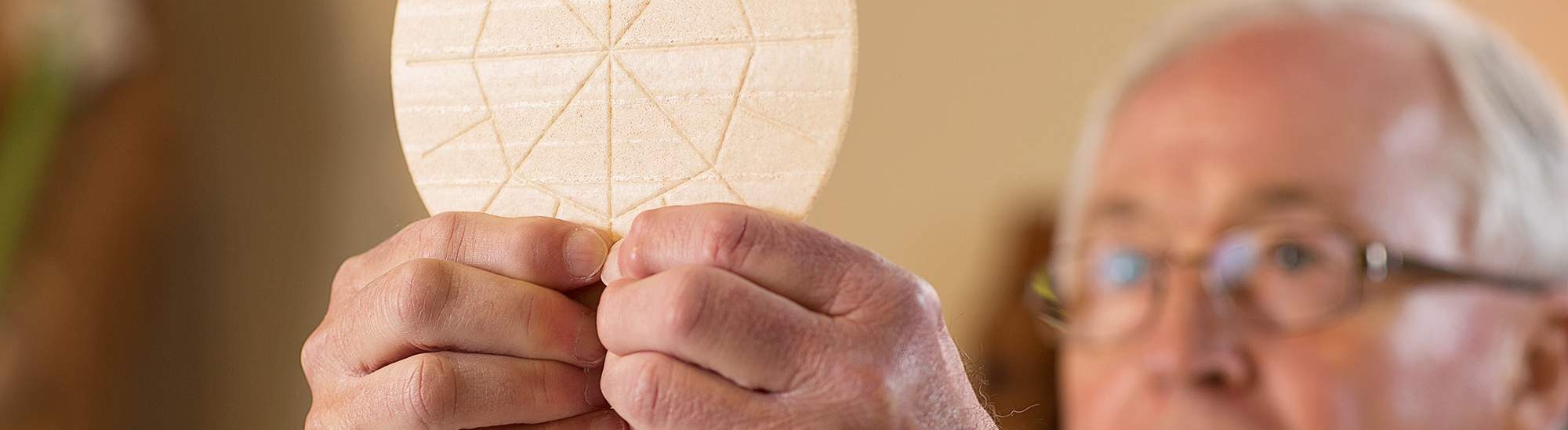
When the sacred host is exposed in the monstrance during Exposition of the Blessed Sacrament we can fix our gaze on the Lord truly present and contemplate His extraordinary love. He is there, silent, waiting, available. Ready to receive our hearts which open to Him.
See, Lord, at Thy service
Low lies here a heart
Lost, all lost in wonder
At the God Thou art.
Contemplating the divine presence we are taken out of ourselves. We are drawn into the transcendent realm; the realm of the Spirit; the realm of the Kingdom of God. Here the material, the sensory, fall away. We are lifted up beyond what can be seen and felt and touched and find our soul stirred into life.
Seeing, touching, tasting
Are in Thee deceived;
How says trusty hearing?
That shall be believed
This is the wonder of our Catholic faith that we celebrate today on this Feast of Corpus Christi. The words of Christ, expressed by St Paul in the second reading, echo today: “This is my body, which is for you; do this as a memorial of me”. Christ gives Himself for us. This gift is experienced in the Holy Eucharist.
‘Corpus Christi’ – the body of Christ. Christ gives Himself for us, to us.
What God’s Son has told me,
Take for truth I do;
Truth Himself speaks truly
Or there’s nothing true.
Archbishop Julian Porteous
Sunday, 19 June 2022