The Real Presence: Be present as He is present

In theological terms, a revealed fact can be proved solely by recurrence to the sources of faith: ie Scripture and Tradition, with which is also bound up the infallible magisterium of the Church.
With regard the Real Presence of Christ in the Eucharist the proof from Scripture is offered both from the words of promise (John 6:26) but more particularly the words of Institution found in the Gospel accounts as explicitly communicated in Paul’s letter to the Corinthians (1 Corinthians 11:23). The proof from Tradition is exhaustive but lies in its simplest terms in a dogma that though not without controversy over the centuries has endured since the time of the Apostles. Not only have the Fathers, and among them St John Chrysostom, defended in theory the permanence of the Real Presence, but the constant practice of the Church has established its truth.
In teaching on the Real Presence of Christ in the Eucharist St John Chrysostom said: “Let us submit to God in all things and not contradict Him, even if what He says seems to contradict our reason and intellect; let His word prevail over our reason and intellect. Let us act in this way with regard to the Eucharistic mysteries, and not limit our attention just to what can be perceived by the senses, but instead hold fast to His words. For His word cannot deceive.”
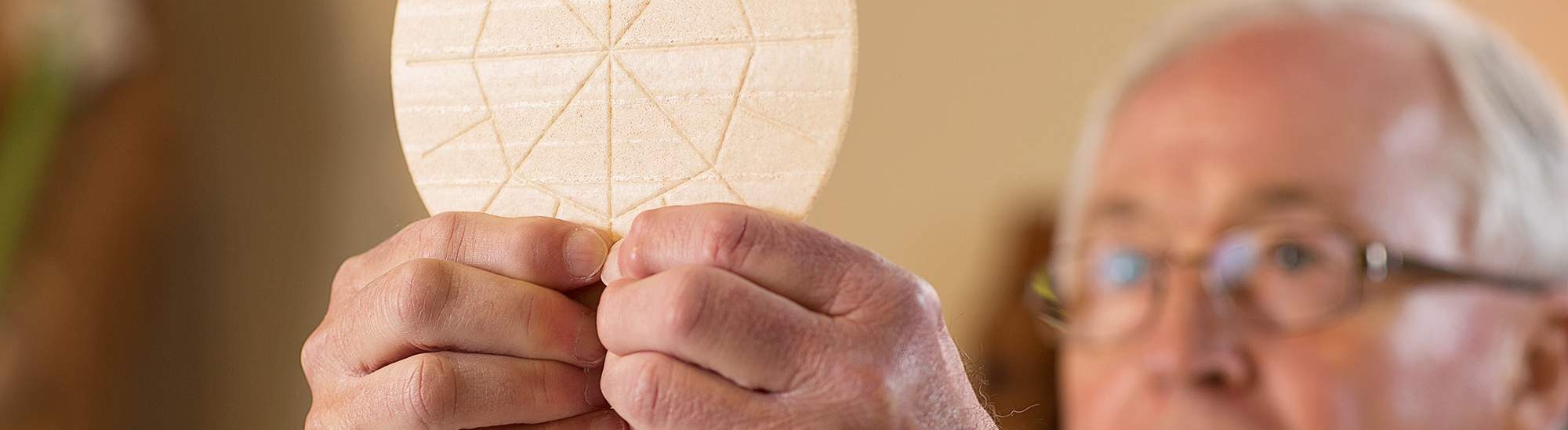
For the ordinary Catholic, Transubstantiation is both a big word and a difficult concept around which to wrap one’s mind. But in the mind of the Church, Transubstantiation is intimately bound up with that of the Real Presence as the consequence of Transubstantiation, understood as a conversion of the total substance, is the transition of the entire substance of the bread and wine into the Body and Blood of Christ.
As members of Christ’s Mystical Body we realise that Christ is present in His Church in many ways. When she prays; performs her works of mercy; preaches and administers the sacraments, which holy in themselves, pour grace into the soul by the power of Christ. However, the dogma of Transubstantiation places the presence of Christ in the Eucharist in an order different from those other presences. Christ is present in the Eucharist by the reality of his body and blood.
In a meditation at the 3rd World Retreat of Priests in 2015, Pope Francis observed that “the Tabernacle can be boring and dry; it’s not a television.” But from deep within his own witness the Holy Father encourages us nevertheless to spend time in front of the Tabernacle not just so we can contemplate Jesus present there but so we allow him to contemplate us. “If you fall asleep before the Tabernacle, don’t have a problem” he told priests, “he is looking at you, let yourself be looked at this way… it’s a beautiful prayer because it is to let Him see you asleep as a father looks at his child who is asleep”.
In the words of Adore te devote “God head here in hiding whom I do adore… What God’s Son has told me take for truth I do, Truth himself speaks truly or there’s nothing true.”
By Michael McKenna, immediate past Director of the Office of Liturgy